Conversation with Steven Seidenberg — Interdisciplinary Artist | Photographer | Author: Beauty in the Margins of Perception

Learning to See Through Repetition, Noticing, and the Emergence of Artistic Voice
What if art is not about creating something new — but about learning how to see what has always been there?
What if attention is not passive observation, but an active, disciplined act of perception?
And what if what we overlook—the marginal, the infrastructural, the seemingly insignificant — is precisely where meaning quietly accumulates?
In this expansive and contemplative conversation, I sat down with Steven Seidenberg — an interdisciplinary artist, photographer, writer, and “private” musician — whose work moves across visual and semantic languages to explore how attention, perception, and meaning are constructed.
His practice resists easy categorisation. Moving between photography, philosophical writing, poetic language, and musical thinking, Steven does not treat mediums as separate disciplines, but as parallel articulations of a singular perceptual inquiry.
At the core of this discussion lies a sustained exploration of one central idea that meaning is not inherent in the world — but shaped through how we attend to it.
00:00:00 – 00:10:45
Origin of Practice: Multiple Mediums, One Sensibility
Steven explains that his creative life is not built around a single medium, but multiple “echoing” practices — writing, photography, music, and other private visual experiments.
Rather than separating disciplines, he sees them as reflections of the same underlying sensibility.
The key idea emerges early:s
• What becomes “public work” is not necessarily what defines the whole practice
• Visibility is shaped by circumstance, not hierarchy of importance

The Architecture of Silence: Abandoned Lives of the Italian South

Kanazawa Vacancy
00:10:45 – 00:15:55
The Margins of Perception: Disregarded, Not Just Abandoned
Steven’s work consistently turns toward spaces that are overlooked, infrastructural, peripheral, and politically or economically neglected. But he makes an important distinction: not all empty spaces are abandoned — many are simply disregarded.
This reframes the lens from aesthetic curiosity to structural awareness, and from visual emptiness to historical and political residue.
Projects such as rural Italian housing (The Architecture of Silence: Abandoned Lives of the Italian South) or Japanese urban vacancy (Kanazawa Vacancy) are not treated as decay or spectacle, but as sites shaped by migration, economic restructuring, demographic shifts, and systemic neglect.
At the same time, these spaces must hold compositional potential.
Meaning emerges not only from context, but from form — through repetition, framing, spatial tension, and rhythm.
Pipevalve Berlin
00:15:55 – 00:27:10
Repetition as Structure: How the Ordinary Becomes Resonant
One of the most defining principles of Steven’s work is his commitment to series-based practice. He does not take isolated photographs.
Why? Because repetition allows transformation: the ordinary becomes uncanny, the overlooked becomes visible, and the insignificant becomes emotionally charged.
He draws from musical minimalism, where repetition is not static, but a site of variation, modulation, and accumulation.
Through repetition, small differences become perceptible, nuance emerges, and emotional weight builds gradually.
Repetition is not monotony — it is the architecture of attention. It is also how artistic voice is formed. Repetition is the voice, essentially, as Steven remarks.
00:27:10 – 00:34:20
The Act of Noticing, Audience, and Responsibility
Steven sees audience reception as structurally limited rather than contingent: not everyone will understand or respond to the work, and this is not a failure but part of how art exists.
Universality is neither expected nor necessary, since misunderstanding is built into meaning-making.
He resists adjusting work to market expectations or simplifying it for accessibility, prioritising internal integrity. Yet he does not reject audience altogether — art always exists in relation to reception, but instead of serving a predefined public, it gradually shapes its own audience over time.
In this sense, art does not adapt to audiences; audiences form around the work as its logic becomes legible.
Noticing differs between artist and viewer:
• For the artist it is immediate and generative
• For the viewer it is delayed and requires sustained attention
The result is not a failure of communication, but a structural gap in the timing of perception between making and receiving.
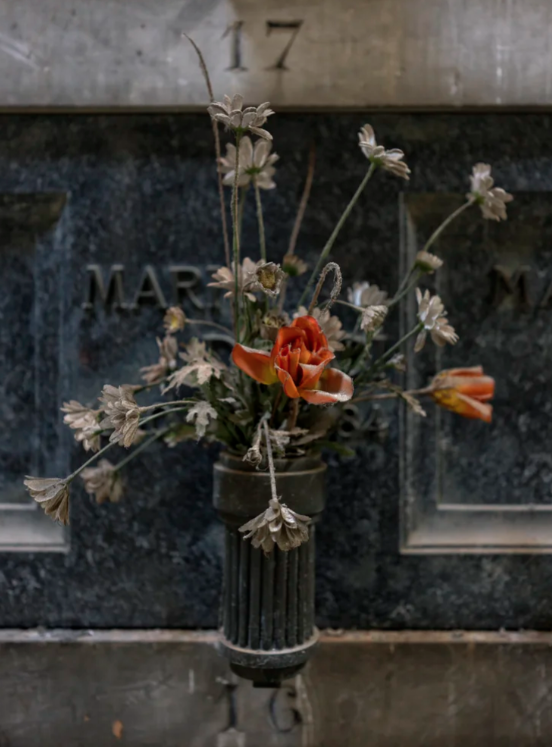
The Plastic Flowers of Staglieno
00:34:20 – 00:39:13
Material, Contradiction & Emotional Charge
In one of the most evocative discussions, Steven reflects on his project photographing plastic flowers in cemeteries.
These objects exist in tension: artificial material placed in sacred space; objects meant to endure, yet slowly degrading; symbols of care, yet subject to neglect.
What draws him is not the object itself, but the contradiction it holds — permanence versus decay, artificial versus organic, memory versus erosion.
Over time, these contradictions generate emotional depth.
The plastic becomes dusty, displaced, and altered by the environment, entering a strange relationship with the natural world it was meant to resist.
This is where meaning emerges — not from symbolism alone, but from material behaviour over time.

Coda
00:39:13 – 00:46:18
Language, Writing, and “Coda” as Perceptual Transition
His writing sits at the intersection of philosophy, literature, and critique of the Western intellectual tradition. Rather than treating it as fixed authority, he uses writing to stretch and test its limits — sometimes through conceptual intensity, sometimes through irony or parody, where humour and philosophical depth coexist.
The work is deliberately semantically layered: it does not resolve into a single meaning but holds multiple registers at once — intellectual, emotional, aesthetic, and rhythmic. Different readers may access different layers depending on their sensitivity and attention.
At its core, this reflects a belief that language mastery is not only technical fluency but long-term attunement between thought and form. Writing becomes a perceptual practice — where language is not just used to express perception, but becomes the medium through which perception itself is refined.
00:46:18 – 00:51:40
Artistic Voice: Formation Through Influence
Steven sees artistic voice as something formed through engagement rather than isolated invention. It develops through sustained exposure to other works, including imitation and even failed imitation, where “failure” becomes a productive distortion that gradually shapes personal style.
Originality, in this sense, is not separation from influence but what remains after absorption, misreading, and transformation.
Artistic practice is always relational, situated within a wider discourse of past and present voices.
The “self” in art is therefore not a starting point, but an emergent outcome formed over time through interaction, repetition, and influence.
00:51:40 – 01:07:17
Attention, Fragmentation, and Ethical Perception
Steven frames contemporary life as a condition of fragmented attention, intensified by social media, which produces constant presence without true perception. His response is not technological nostalgia, but a perceptual ethic: the ability to tolerate “not knowing” as a productive state.
He argues that resisting immediate retrieval — of facts, of updates, of others’ lives — reopens space for thought, imagination, and deeper attention. Moments of distance and unknowing are not absence, but conditions for clarity and relational depth, both in art and in life.
At the societal level, this becomes an ethical and political position: sustaining attention against systems that fragment it, and remaining critically aware of structures (including capitalism and digital culture) that normalise distraction and passive consumption.
I asked him about his outlook on the future of humanity— positive or negative—and he closed with a grounding quote from Gramsci.
pessimism of the intellect, optimism of the will — a recognition of structural difficulty paired with an active commitment to continue thinking, perceiving, and acting meaningfully within it.
You can learn more about Steven’s work on his website:
Website: https://www.stevenseidenberg.com/
Follow him on:Instagram: https://www.instagram.com/steven.seidenberg/